Overview
A quick conceptual view of parallel computing. We start with a serial algorithm, specifically a sort algorithm.

The algorithm starts with an array of integers. Simply, the application iterates through each integer and moves the integers to the correct array spot to make the array sorted. As we move through the array, we eventually get to the last integer, and thus have a numerically sorted array.
While this sort algorithm is simple, and their are more efficient ways to sort an array. The concept is simple enough to compare to a parallel approach of the same algorithm.
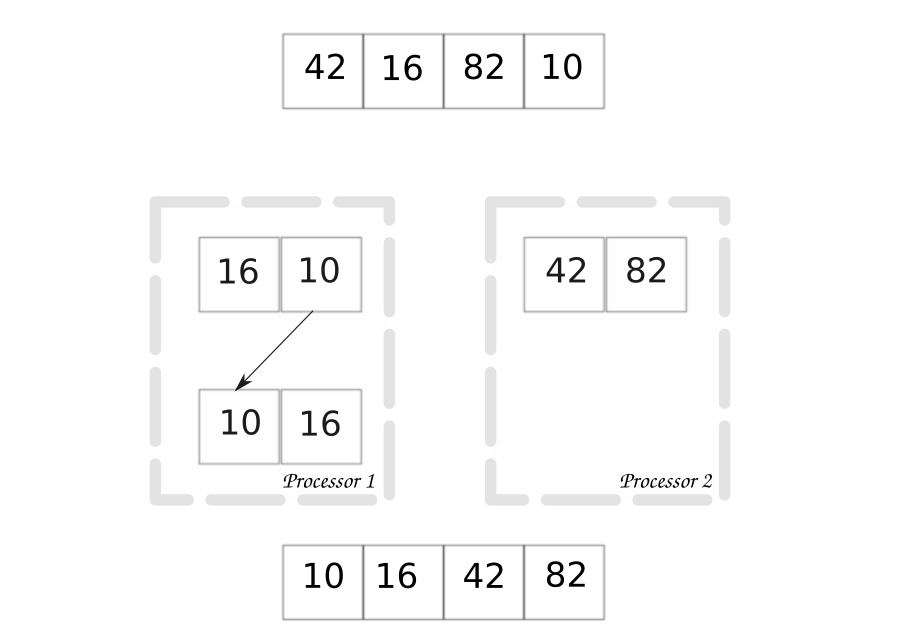
In the parallel algorithm, we split the array into two subsets by some criteria. Here, we give processor 1 all integers less than 40, and processor 2 gets all integers greater than 40. Each processor then sorts their own array of integers. After we simply concatenate the sorted sub arrays to get the entire sorted array.
Note
Parallel computing requires some shared memory between processors. In this instance, each processor shares the initial integer array. This is why parallel computing can sometimes be refered to as shared memory computing. This is why parallel computing will not reduce memory usage, and therefore is not attenable on large memory applications. We will see how to handle large memory use when we discuss distributed computing.